JEE Main 2020 Chemistry question — Depression in freezing point
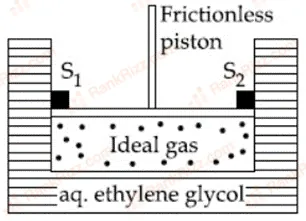
A cylinder containing an ideal gas (0.1 mol of 1.0 dm) is in thermal equilibrium with a large volume of 0.5 molal aqueous solution of ethylene glycol at its freezing point. If the stoppers and (as shown in the figure) are suddenly withdrawn, the volume of the gas in litres after equilibrium is achieved will be ___________.
(Given, (water) K kg mol, R dm atm K mol)
SOLUTION
Step 1: Find the Temperature of the System ()
The problem states that the gas is in thermal equilibrium with a large volume of a aqueous solution of ethylene glycol at its freezing point. We can find this temperature by calculating the depression in freezing point ():
Where:
Since the normal freezing point of pure water is , the freezing point of the solution (and thus the temperature of the system) is:
Step 2: Determine the Final Pressure ()
The diagram shows a frictionless piston open to the atmosphere. When the stoppers and are withdrawn, the piston is free to move up or down until the internal pressure of the gas perfectly balances the external atmospheric pressure.
Therefore, at final equilibrium, the pressure of the gas is equal to standard atmospheric pressure:
Step 3: Calculate the Final Volume () using the Ideal Gas Law
Now, we apply the ideal gas equation () to isolate and solve for the final volume :
Substitute the given parameters:
Since , the volume of the gas is approximately .
Conclusion:
The withdrawal of the stoppers allows the gas to expand against the constant atmospheric pressure until it hits equilibrium at .
Answer: 2.18
Tagged Depression in freezing point. Machine-assigned, so read it as a strong shortlist rather than a verdict.