JEE Main 2020 Chemistry question — Solubility of gases and Henry's law
Henry's constant (in kbar) for four gases , , and in water at 298 K is given below:
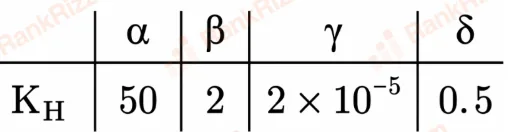
(density of water = 10 kg m at 298 K) This table implies that:
SOLUTION
For a gas dissolved in a liquid Henry’s law is stated as
where is the partial pressure of the gas (in the same units as ) and is the mole-fraction of the dissolved gas in the solution. From the equation we immediately notice that, for any fixed pressure, a smaller value of must give a larger value of ; therefore the smaller the Henry’s constant, the greater is the solubility of the gas.
Checking option A
The constants are
Because 50 kbar is the largest value, actually has the least solubility, not the greatest. So option A is wrong.
Checking option B
No numerical value of at 308 K has been supplied, and the question does not state whether dissolution of is exothermic (for which normally rises with temperature) or endothermic (for which it would fall). Thus we cannot deduce the solubility change only from the given data. Hence option B cannot be affirmed and is taken as incorrect.
Checking option C
A 55.5 molal solution means 55.5 mol of the gas dissolved per 1 kg of water. Because the molar mass of water is , 1 kg of water contains
The dissolved gas also has Hence the total number of moles in the solution is
The mole-fraction of the gas is therefore
Using Henry’s law with , we have
Because we convert
This exactly matches the value stated in option C, so option C is correct.
Checking option D
With the same 55.5 molal concentration we have the same mole-fraction
For ,
Applying Henry’s law gives
Converting to bar,
This is far lower than 1 bar, so option D is false.
Among the four statements, only option C is consistent with Henry’s law and the numerical data.
Hence, the correct answer is Option C.
Tagged Solubility of gases and Henry's law. Machine-assigned, so read it as a strong shortlist rather than a verdict.