JEE Main 2025 Chemistry question — Relative lowering of vapour pressure
Match List-I with List-II .
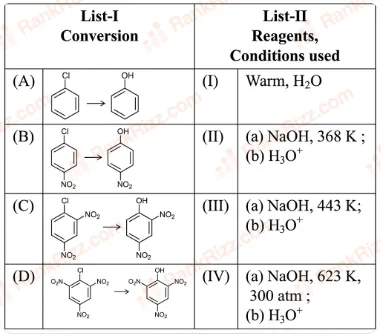
Choose the correct answer from the options given below :
SOLUTION
In every conversion a chloride atom on an aromatic ring is being replaced by to give a phenol. This transformation proceeds by a nucleophilic aromatic substitution (SNAr) of the ion by the nucleophile .
Rate of SNAr increases sharply when the ring has strong and groups (such as ) at the ortho and/or para positions. These groups stabilise the intermediate Meisenheimer complex by delocalising the negative charge.
Therefore, the more groups present, the milder the conditions required for hydrolysis. Arrange the four substrates in increasing ease of hydrolysis:
chlorobenzene < p-nitrochlorobenzene < 2,4-dinitrochlorobenzene < picryl chloride (2,4,6-trinitrochlorobenzene).
Now match the reagents/conditions given in List-II with this order:
Case 1: Chlorobenzene phenol
Very unreactive; Dow’s process is used.
Reagents: , , , then Item (IV).
Case 2: p-Nitrochlorobenzene p-Nitrophenol
One group activates the ring; moderate temperature is sufficient.
Reagents: , , then Item (III).
Case 3: 2,4-Dinitrochlorobenzene 2,4-Dinitrophenol
Two groups give higher activation; still milder conditions than above.
Reagents: , , then Item (II).
Case 4: Picryl chloride (2,4,6-Trinitrochlorobenzene) Picric acid (2,4,6-Trinitrophenol)
Three groups make the ring so activated that simple warming with water suffices.
Reagent/condition: warm Item (I).
Thus the correct pairing is:
(A) (IV), (B) (III), (C) (II), (D) (I).
Comparing with the options, this corresponds to Option C.
Tagged Relative lowering of vapour pressure. Machine-assigned, so read it as a strong shortlist rather than a verdict.