JEE Main 2025 Chemistry question — Osmosis and osmotic pressure
XY is the membrane/partition between two chambers 1 and 2 containing sugar solutions of concentration and () mol . For the reverse osmosis to take place identify the correct condition. (Here and are pressures applied on chamber 1 and 2)
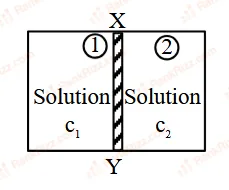
(A) Membrane/Partition ; Cellophane,
(B) Membrane/Partition ; Porous.
(C) Membrane/Partition ; Parchment paper,
(D) Membrane/Partition : Cellophane,
Choose the correct answer from the options given below :
SOLUTION
To identify the correct conditions for reverse osmosis in this setup, we must understand the principles of osmosis, applied pressure, and membrane permeability.
The concentration of the solution in Chamber 1 is greater than that in Chamber 2, i.e.,
Under natural osmotic conditions, the solvent flows from the region of lower solute concentration (Chamber 2) to the region of higher solute concentration (Chamber 1) through a semipermeable membrane. The osmotic pressure is the minimum pressure that must be applied to the concentrated solution to stop this natural flow of solvent.
In reverse osmosis, the solvent is forced to move in the opposite direction, from the concentrated solution to the dilute solution. To achieve this, pressure must be applied on the concentrated side (Chamber 1), and the applied pressure must be greater than the osmotic pressure. Hence, the required condition is
The membrane separating the two chambers must also be a semipermeable membrane (SPM), which allows only solvent molecules to pass through while preventing the passage of solute particles. Cellophane and parchment paper act as semipermeable membranes, whereas an ordinary porous partition allows both solute and solvent to pass through and therefore cannot produce reverse osmosis.
Evaluating the given statements:
- (A) Cellophane with : Correct. Cellophane acts as a semipermeable membrane, and applying pressure greater than the osmotic pressure on the concentrated side produces reverse osmosis.
- (B) Porous partition with : Incorrect. A porous partition is not semipermeable, and applying pressure on the dilute side cannot produce reverse osmosis.
- (C) Parchment paper with : Correct. Parchment paper behaves as a semipermeable membrane, and the applied pressure satisfies the condition required for reverse osmosis.
- (D) Cellophane with : Incorrect. Although cellophane is a suitable membrane, applying pressure on the dilute side does not reverse the direction of solvent flow.
Therefore, the correct statements are A and C only.
Hence, the correct answer is
Tagged Osmosis and osmotic pressure. Machine-assigned, so read it as a strong shortlist rather than a verdict.