JEE Main 2024 Chemistry question — Preliminary and dry tests
Match List I with List II
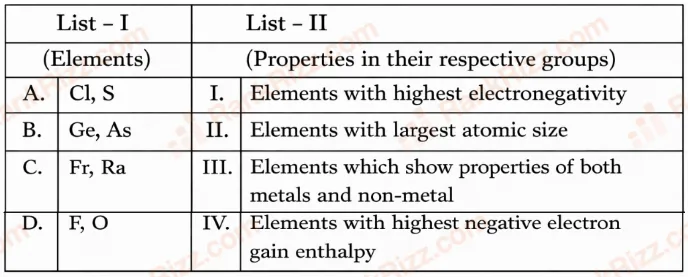
Choose the correct answer from the options given below:
SOLUTION
First write down the two lists exactly as they appear in the question.
List I (Types of reactive intermediates / reagents)
A. Electrophile
B. Nucleophile
C. Free-radical
D. Carbenium (carbocation) ion
List II (Typical examples)
I. (methyl carbocation)
II. (chlorine radical)
III. (ammonia)
IV. (boron trifluoride)
Now decide which example fits each description.
Case A (Electrophile)
An electrophile is an electron-deficient Lewis acid that can accept an electron pair. has an incomplete octet on boron and readily accepts electron density, so it is a classic electrophile.
Hence A IV.
Case B (Nucleophile)
A nucleophile is electron-rich and donates an electron pair. possesses a lone pair on nitrogen and behaves as a Lewis base, i.e. a nucleophile.
Hence B III.
Case C (Free-radical)
A free-radical carries one unpaired electron. clearly has a single unpaired electron.
Hence C II.
Case D (Carbenium / Carbocation)
A carbenium ion is a positively charged carbon species such as .
Hence D I.
Collecting all matches: A-IV, B-III, C-II, D-I.
The only option that contains this combination is:
Option C which is: A-IV, B-III, C-II, D-I.
Tagged Preliminary and dry tests. Machine-assigned, so read it as a strong shortlist rather than a verdict.