JEE Main 2026 Chemistry question — Detection of functional groups
Match List - I with List - II.
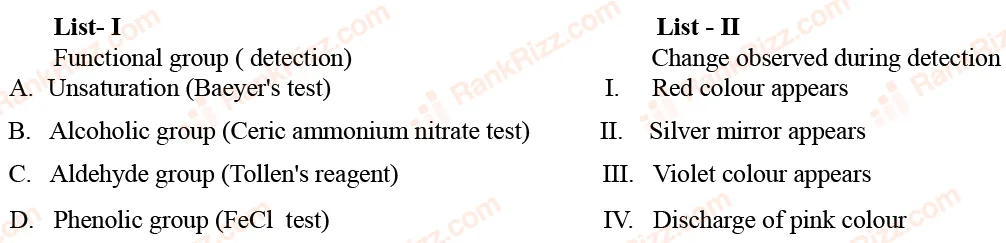
choose the correct answer from the options given below :
SOLUTION
A. Unsaturation (Baeyer's Test) IV. Discharge of pink colour
Baeyer's reagent is a cold, alkaline solution of potassium permanganate (), which is deep pink/purple. When it reacts with an alkene or alkyne, the ion is reduced to (a brown precipitate), causing the pink colour to disappear (decolourise).
B. Alcoholic group (Ceric ammonium nitrate test) I. Red colour appears
Ceric ammonium nitrate () is an orange-yellow reagent. When added to an alcohol, it forms a alkoxy cerium(IV) complex, which results in a characteristic wine-red colouration.
C. Aldehyde group (Tollen's reagent) II. Silver mirror appears
Tollen's reagent contains the silver-ammonia complex . Aldehydes reduce these silver ions to metallic silver, which deposits on the inner walls of the test tube, creating a shining silver mirror.
D. Phenolic group ( test) III. Violet colour appears
Phenols react with neutral ferric chloride to form a coordination complex with the iron. For simple phenol, this complex is typically violet or purple, though other phenols can produce green or blue colours.
Tagged Detection of functional groups. Machine-assigned, so read it as a strong shortlist rather than a verdict.