JEE Main 2022 Chemistry question — Classification of polymers and types of polymerisation
Match List I with List II
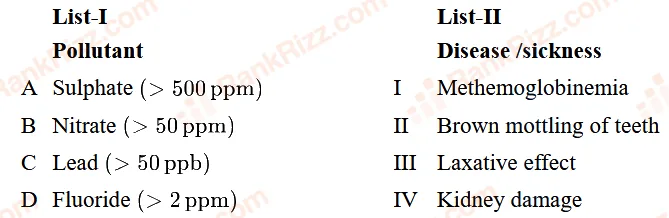
Choose the correct answer from the options given below
SOLUTION
We need to match pollutants in water with the diseases they cause at the given concentration levels.
(A) Sulphate (>500 ppm): Excess sulphate in water causes a laxative effect (diarrhoea). This matches with (III).
(B) Nitrate (>50 ppm): Excess nitrate causes methemoglobinemia (also called "blue baby syndrome"). Nitrate gets reduced to nitrite in the body, which converts haemoglobin to methemoglobin, reducing oxygen-carrying capacity. This matches with (I).
(C) Lead (>50 ppb): Lead is a toxic heavy metal that causes kidney damage and also damages the nervous system and liver. This matches with (IV).
(D) Fluoride (>2 ppm): Excess fluoride causes brown mottling of teeth (dental fluorosis). It also causes bone disease (skeletal fluorosis) at higher concentrations. This matches with (II).
A - III, B - I, C - IV, D - II
The correct answer is Option B: A-III, B-I, C-IV, D-II.
Tagged Classification of polymers and types of polymerisation. Machine-assigned, so read it as a strong shortlist rather than a verdict.