JEE Main 2022 Chemistry question — Aluminium and its compounds
The geometry around boron in the product 'B' formed from the following reaction is
SOLUTION
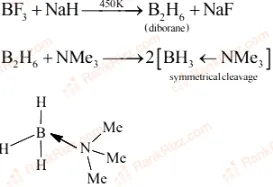
Step 1: Formation of Product 'A'
When boron trifluoride () reacts with sodium hydride () at around , it undergoes a reduction reaction to form diborane () along with sodium fluoride ():
Therefore, product 'A' is diborane, .
Step 2: Formation of Product 'B'
Diborane () is an electron-deficient molecule that easily undergoes cleavage by Lewis bases. When treated with a relatively small, bulky tertiary amine like trimethylamine (), it undergoes symmetric cleavage to yield a stable Lewis acid-base adduct:
Therefore, product 'B' is the monomeric adduct, .
Hybridization and Geometry Around Boron in Product 'B':
In the adduct , the boron atom accepts a lone pair of electrons from the nitrogen atom of the trimethylamine molecule via a coordinate (dative) bond.
- The central Boron atom forms 3 covalent bonds with hydrogen atoms () and 1 coordinate bond with the nitrogen atom ().
- This gives a total of 4 bond pairs and 0 lone pairs on the boron atom.
- According to the VSEPR theory, a steric number of 4 corresponds to hybridization.
The spatial arrangement corresponding to hybridization with zero lone pairs is completely symmetrical, giving it a tetrahedral geometry.
Conclusion:
The coordination of the lone pair from trimethylamine changes the geometry around the boron atom from trigonal planar (in fragments) to tetrahedral in the final complex.
Answer: Option B — tetrahedral
Tagged Aluminium and its compounds. Machine-assigned, so read it as a strong shortlist rather than a verdict.