JEE Main 2020 Chemistry question — Electrophilic addition to alkenes
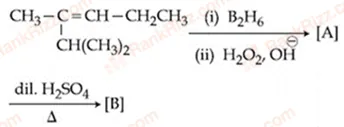
The major product [B] in the following sequence of reactions is:
SOLUTION
-
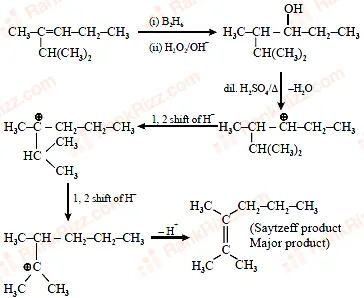
Step 1: Hydroboration-Oxidation (Formation of Alcohol)
The starting alkene undergoes hydroboration-oxidation using followed by alkaline . This reaction results in the net anti-Markovnikov addition of water across the double bond with syn-stereochemistry, yielding the secondary alcohol:
-
Step 2: Carbocation Formation via Dehydration
Treating this alcohol with dilute sulfuric acid and heat () leads to protonation of the hydroxyl group followed by the loss of a water molecule (). This generates a secondary carbocation:
-
Step 3: Carbocation Rearrangement (1,2-Hydride Shift)
To achieve greater stability, a 1,2-hydride shift ( shift) occurs from the adjacent tertiary carbon to the positively charged secondary carbon atom. This rearranges the intermediate into a highly stable tertiary carbocation.
-
Step 4: Deprotonation to the Saytzeff Product (Formation of B)
Finally, elimination of a proton () occurs from the adjacent carbon following Saytzeff's rule to form the most highly substituted, conjugated, and thermodynamically stable alkene as the major product:
Conclusion:
The reaction sequence goes through an anti-Markovnikov alcohol formation, followed by a carbocation generation that undergoes a thermodynamic hydride shift to yield the most substituted alkene (2,3-dimethylhex-2-ene).
Answer: Option B — 2,3-dimethylhex-2-ene
Tagged Electrophilic addition to alkenes. Machine-assigned, so read it as a strong shortlist rather than a verdict.