JEE Main 2020 Chemistry question — Electrophilic addition to alkenes
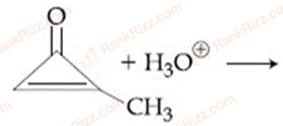
The major product in the following reaction is:
SOLUTION
-
Protonation of the Carbonyl Oxygen:
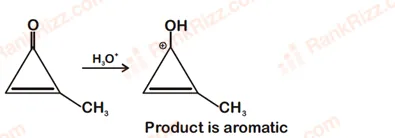
The lone pair of electrons on the carbonyl oxygen atom attacks a proton from . This forms a protonated conjugate acid intermediate:
-
Resonance Stabilization via Aromaticity:
By shifting the -electrons of the carbonyl double bond completely onto the electronegative oxygen atom, a highly stable resonance contributor is generated. This structures a cyclopropenyl cation ring core:
This cyclic intermediate contains a continuously conjugated planar loop of 3 hybridized carbon atoms sharing exactly electrons. According to Hückel's Rule ( where ), this ring system possesses immense thermodynamic stability due to its aromatic character.
Conclusion:
The major species remains locked in its protonated, highly stable aromatic hydroxy-functionalized cyclopropenium form rather than reverting or undergoing ring-opening.
Answer: Option D (The protonated aromatic cyclopropenium cation structure)
Tagged Electrophilic addition to alkenes. Machine-assigned, so read it as a strong shortlist rather than a verdict.