JEE MAIN 2024 · 08 APR S1+4 / −1MEDIUMTRANSCRIBED
JEE Main 2024 Chemistry question — Electrophilic aromatic substitution
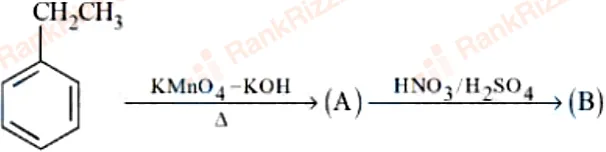
Major product of the following reaction has ______ -bond.
SOLUTION
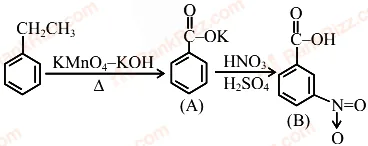
Step 1: Formation of Product (A)
- Reactant: Ethylbenzene ()
- Reagent: (Strong oxidizing agent)
- Reaction: Vigorous oxidation of the alkyl side chain containing benzylic hydrogens. Regardless of the chain length, the alkyl group is completely oxidized down to a carboxylic acid group attached to the benzene ring.
- Product (A): Benzoic acid ()
Step 2: Formation of Major Product (B)
- Reactant: Benzoic acid ()
- Reagent: (Nitrating mixture)
- Reaction: Electrophilic aromatic substitution (Nitration). Since the carboxylic acid group () is a strongly deactivating and meta-directing group, the nitro group () attacks the meta position.
- Product (B): m-Nitrobenzoic acid (3-nitrobenzoic acid)
Step 3: Counting the -bonds in Product (B)
- Benzene Ring: Contains 3 -bonds (alternate double bonds).
- Carboxylic Acid Group (): Contains 1 -bond (from the double bond).
- Nitro Group (): Contains 1 -bond (resonating within the bond system).
Tagged Electrophilic aromatic substitution. Machine-assigned, so read it as a strong shortlist rather than a verdict.