JEE Main 2026 Chemistry question — Reactions of alkanes
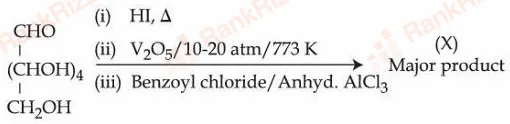
Consider the following reactions. Total number of electrons in the bonds and lone pair of electrons in the product (X) is :
SOLUTION
Glucose undergoes a series of reactions to give the final product (X).
On treatment with excess (HI) and heating, all the hydroxyl groups and the aldehyde group present in glucose are reduced, producing (n)-hexane.
The (n)-hexane obtained is then subjected to catalytic oxidation in the presence of (V_2O_5) at (773,K), which results in dehydrocyclization to form benzene.
Finally, benzene undergoes Friedel-Crafts acylation with benzoyl chloride in the presence of anhydrous (AlCl_3) to produce benzophenone.
Hence, the final product (X) is benzophenone.
To determine the total number of electrons present in its (\pi)-bonds and lone pairs, consider its structure:
- Each phenyl ring contains (3) (\pi)-bonds. Therefore, two phenyl rings contain (6) (\pi)-bonds.
- The carbonyl group ((C=O)) contains one additional (\pi)-bond.
Thus, the total number of (\pi)-bonds is
Since each (\pi)-bond contains (2) electrons,
The oxygen atom of the carbonyl group possesses two lone pairs, contributing
Therefore, the total number of electrons present in the (\pi)-bonds and lone pairs is
Hence, the correct answer is 18.
Tagged Reactions of alkanes. Machine-assigned, so read it as a strong shortlist rather than a verdict.