JEE Main 2020 Chemistry question — Electrophilic addition to alkenes
The major product [C] of the following reaction sequence will be:
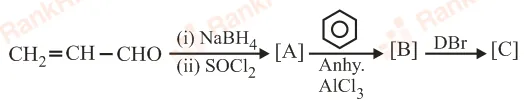
SOLUTION
The starting compound is ethanal, .
Case 1: Formation of the aldol (compound B)
Ethanal possesses at least one -hydrogen. In the presence of a dilute aqueous base (usually or , 273-278 K), one molecule of ethanal is enolised and the enolate ion thus formed attacks the carbonyl carbon of a second molecule of ethanal. This is the classic aldol addition.
The overall transformation is
The product B is 3-hydroxybutanal, a β-hydroxy aldehyde (aldol).
Case 2: Dehydration of the aldol (compound C)
When the reaction mixture is warmed (or simply allowed to stand for a longer time under the same basic conditions), the β-hydroxy aldehyde undergoes base-induced dehydration (loss of water) to give an α,β-unsaturated aldehyde.
The elimination occurs between the β-hydroxyl group and an α-hydrogen:
The product C is crotonaldehyde (but-2-enal). Experimentally, the trans (E) stereoisomer predominates because it is more stable.
Hence the major product C is the α,β-unsaturated aldehyde , represented in the options as Option A.
Final answer: Option A which is: trans-but-2-enal (crotonaldehyde).
Tagged Electrophilic addition to alkenes. Machine-assigned, so read it as a strong shortlist rather than a verdict.