JEE MAIN 2021 · 31 AUG S2+4 / −1MEDIUMTRANSCRIBED
JEE Main 2021 Chemistry question — Electrophilic addition to alkenes
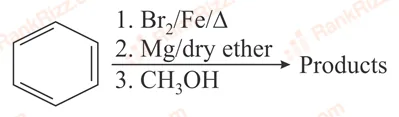
For the following sequence of reactions, the correct products are:
SOLUTION
Here is the summary of the chemical sequence and why the methyl group is left behind, broken down into key points:
- Step 1: Bromination: Benzene reacts with bromine and an iron catalyst to form bromobenzene.
- Step 2: Grignard Formation: The bromobenzene reacts with magnesium metal in dry ether. Magnesium inserts itself into the carbon-bromine bond, creating the highly reactive Grignard reagent (phenylmagnesium bromide).
- The Dual Nature of Grignard Reagents: Because the magnesium pushes its electrons onto the carbon ring, that specific carbon atom becomes heavily negatively charged. This makes it both a powerful nucleophile (wants to attach to other carbons) and an extremely strong base (desperate to grab free hydrogen protons).
- The Methanol Target: Methanol () has an oxygen-hydrogen bond, making that specific hydrogen atom slightly acidic.
- The Speed Race: In chemistry, acid-base reactions are essentially instantaneous and significantly faster than nucleophilic attacks.
- The Final Outcome: Instead of taking the time to attack the carbon of the methyl group, the strongly basic Grignard reagent instantly snatches the easy, acidic hydrogen off the methanol.
- The Products: Grabbing that hydrogen converts the ring back into pure benzene, while the completely unreacted methyl group is left behind as a harmless methoxide byproduct.
Tagged Electrophilic addition to alkenes. Machine-assigned, so read it as a strong shortlist rather than a verdict.