JEE MAIN 2023 · 30 JAN S1+4 / −1MEDIUMTRANSCRIBED
JEE Main 2023 Chemistry question — Electrophilic addition to alkenes
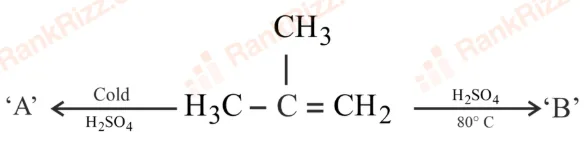
The major products 'A' and 'B', respectively, are
SOLUTION
Key idea: Cold adds across the C=C bond (Markovnikov) to give an alkyl hydrogen sulphate. At 80 °C, the 3° carbocation instead attacks a second alkene molecule, and isobutylene dimerises.
- Cold: . So A is tert-butyl hydrogen sulphate.
- 80 °C: adds to the end of another isobutylene, giving . This cation loses .
- It loses from the internal to give the more substituted alkene: , 2,4,4-trimethylpent-2-ene. This is B.
- Option (A) shows A = and B = the trimethylpentene, in the right order. Option (B) has them reversed. Options (C) and (D) show a saturated alkane, which this reaction does not give.
Answer: (A)
Tagged Electrophilic addition to alkenes. Machine-assigned, so read it as a strong shortlist rather than a verdict.