JEE MAIN 2022 · 27 JUN S2+4 / −1MEDIUMTRANSCRIBED
JEE Main 2022 Chemistry question — Reactions of alkynes
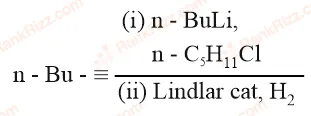
What will be the major product of following sequence of reactions?
SOLUTION
Step 1: Alkylation of the Terminal Alkyne
The starting material is a terminal alkyne: n-Bu-C≡CH.
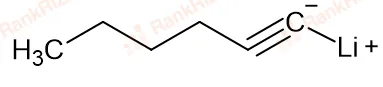
- Reaction with n-BuLi: strong organolithium base deprotonates the terminal acetylenic proton to form a nucleophilic carbanion:
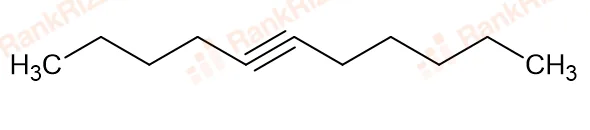
n-Bu-C≡C- Li+ - Reaction with n-C5H11Cl: The carbanion performs an SN2 nucleophilic substitution on the primary alkyl halide, extending the chain into an internal alkyne:
- n-Bu-C≡C-C5H11
Step 2: Stereoselective Reduction
The internal alkyne is treated with Lindlar's Catalyst (Pd/CaCO3 poisoned with quinoline) and H2.
- Lindlar's catalyst is a heterogeneous, deactivated catalyst that reduces alkynes selectively into alkenes without reducing them all the way to alkanes.
- The mechanism occurs via syn-addition (both hydrogen atoms deliver to the same face of the triple bond simultaneously).
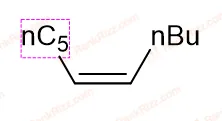
- This stereospecific addition yields exclusively a cis-alkene (Z-alkene) geometry.
Correct Option Match:
The product must contain the n-Bu and -C5H11 groups positioned on the same side of the newly formed carbon-carbon double bond carbon axis. This matches structural geometry option C.
The product must contain the n-Bu and -C5H11 groups positioned on the same side of the newly formed carbon-carbon double bond carbon axis. This matches structural geometry option C.
Tagged Reactions of alkynes. Machine-assigned, so read it as a strong shortlist rather than a verdict.