JEE Main 2025 Chemistry question — Reactions of alkynes
The product (A) formed in the following reaction sequence is
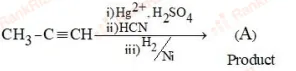
SOLUTION
The given sequence converts an alkyl halide into an alkyne by the well-known elimination addition double-elimination alkylation route. For clarity, let us denote the starting compound as (ethyl bromide) and follow every step.
Step 1 : β-elimination (dehydrohalogenation)
Reagent : alcoholic (strong base).
Reaction :
Product : ethene.
Step 2 : Electrophilic addition of bromine
Reagent : (cold, non-polar solvent).
Reaction : (1,2-dibromoethane).
Thus we have introduced two vicinal bromine atoms, which are a
precursor for preparing an alkyne.
Step 3 : Double dehydrohalogenation
Reagent : excess alcoholic (or , any strong base).
Each removes one molecule of ; two such eliminations
convert the vic-dibromide into an alkyne:
Product : ethyne (acetylene), a terminal alkyne having an acidic hydrogen.
Step 4 : Formation of acetylide ion
Reagent : (sodamide, very strong base).
Reaction :
The terminal proton is removed, giving the nucleophilic
acetylide ion.
Step 5 : Alkylation (SN2) with ethyl bromide
Reagent : another mole of .
The acetylide ion undergoes an reaction with the
primary alkyl bromide:
Final product (A) : , i.e. 1-butyne.
Among the given choices, Option B corresponds to 1-butyne, so
Option B which is: 1-butyne.
Tagged Reactions of alkynes. Machine-assigned, so read it as a strong shortlist rather than a verdict.