JEE Main 2023 Chemistry question — Reactions of alkanes
Maximum number of isomeric monochloro derivatives which can be obtained from 2,2,5,5-tetramethylhexane by chlorination is _____
SOLUTION
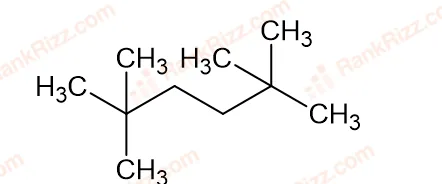
The structural formula of 2,2,5,5-tetramethylhexane can be written as:
This molecule is highly symmetrical, with a plane of symmetry right down the middle of the C3-C4 bond.
There are only two positions containing hydrogen atoms where chlorination can occur:
- Position A (Methyl groups): The 12 hydrogens on the four terminal groups attached to the quaternary carbons (C2 and C5) are completely equivalent.
- Position B (Methylene groups): The 4 hydrogens on the two groups (C3 and C4) are also completely equivalent.
Chlorination at Position A (Methyl Groups)
Substituting one hydrogen from any of the methyl groups gives:
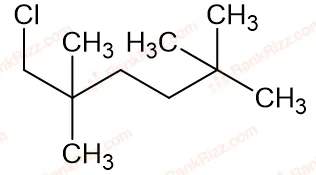
- Chirality: The carbon attached to the group is bonded to two identical methyl groups (). Therefore, this molecule has no chiral center and is achiral.
- Isomer Count: 1 (structural isomer)
Chlorination at Position B (Methylene Groups)
Substituting one hydrogen from either C3 or C4 gives:
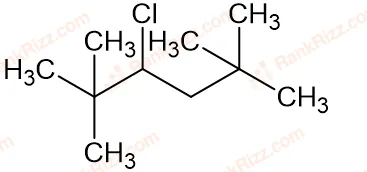
- Chirality: Let's look at the groups attached to the chlorinated carbon (C3):
- (tert-butyl group)
- (neopentyl group)
Since all 4 groups attached to C3 are completely different, C3 is a chiral (asymmetric) carbon center.
- Isomer Count: Because it contains one chiral center, it exists as a pair of enantiomers (- and -forms). This gives 2 stereoisomers.
Tagged Reactions of alkanes. Machine-assigned, so read it as a strong shortlist rather than a verdict.