JEE MAIN 2026 · 23 JAN S2+4 / −1MEDIUMTRANSCRIBED
JEE Main 2026 Chemistry question — Electrophilic aromatic substitution
Consider the following reaction of benzene.

In compound (Q), the percentage of oxygen is ___ %. (Nearest integer)
SOLUTION
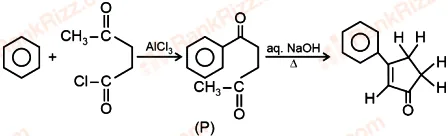
We need to determine the mass percentage of oxygen in compound (Q) obtained from the given reaction sequence starting with benzene.
1. Reaction Analysis:
-
Step 1: Friedel-Crafts Acylation (Formation of P)
Benzene reacts with the acyl chloride end of the bifunctional reagent in the presence of anhydrous . The chlorine atom acts as a leaving group, forming an acylium ion intermediate that attacks the benzene ring.
(as shown in the reaction scheme: a benzene ring substituted with a chain). -
Step 2: Intramolecular Aldol Condensation (Formation of Q)
Treating the 1,3-dione (P) with aqueous and heat () drives an intramolecular aldol condensation. The base abstracts an acidic alpha-proton from the terminal methyl group () to form a nucleophilic enolate ion. This ion attacks the benzylic carbonyl carbon to form a stable 5-membered ring. Subsequent dehydration () yields the final cyclic -unsaturated ketone product (Q) displayed in the diagram.
2. Mass Percentage of Oxygen:
Answer: 10
Tagged Electrophilic aromatic substitution. Machine-assigned, so read it as a strong shortlist rather than a verdict.