JEE MAIN 2026 · 22 JAN S2+4 / −1MEDIUMTRANSCRIBED
JEE Main 2026 Chemistry question — Reactions of alkynes
Consider the following reaction :
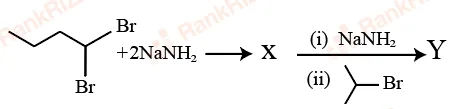
The product Y formed is :
SOLUTION
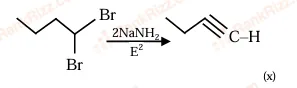
Step 1: Formation of X (Dehydrohalogenation)
The starting material is 1,1-dibromobutane. When treated with 2 equivalents of sodamide (), it undergoes a double dehydrohalogenation.
- Reaction: Elimination reaction (specifically -elimination).
- Intermediate X: 1-Butyne ().
- Mechanism: Strong base removes protons and eliminates twice to form a triple bond at the terminal position.
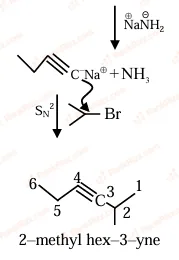
Step 2: Formation of Y (Alkylation of Terminal Alkyne)
Terminal alkynes are acidic. This step involves two sub-steps:
- Deprotonation: removes the acidic terminal proton from 1-butyne to form an acetylide ion ().
- Nucleophilic Substitution (): The acetylide ion acts as a nucleophile and attacks isopropyl bromide (2-bromopropane).
- Reaction: Alkyne Alkylation (Nucleophilic Substitution).
- Product Y: 2-methylhex-3-yne.
- Mechanism: The carbon chain is extended by connecting the terminal alkyne carbon to the isopropyl group.
Tagged Reactions of alkynes. Machine-assigned, so read it as a strong shortlist rather than a verdict.