JEE Main 2012 Chemistry question — Reactions of alkynes
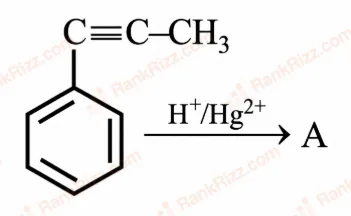
In the given reaction, the product 'A' is
SOLUTION
When an unsymmetrical alkyne reacts with and , water adds across the triple bond following Markovnikov's rule. The electrophile () attacks the carbon that yields the more stable carbocation intermediate.
The triple bond is between the carbon attached to the phenyl ring () and the carbon attached to the methyl group ():
Because the benzylic carbocation is significantly more stable, the nucleophile ( from water) will attack .
The addition of and results in an unstable enol intermediate:
Enols are generally unstable and rapidly undergo tautomerization to form the more thermodynamically stable carbonyl compound (keto form).
Tagged Reactions of alkynes. Machine-assigned, so read it as a strong shortlist rather than a verdict.