JEE MAIN 2006TRANSCRIBED
JEE Main 2006 Chemistry question — Alkenes: preparation and stability
The alkene formed as a major product in the above elimination reaction is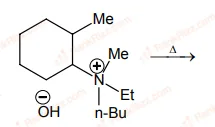
SOLUTION
Key idea: Heating a quaternary ammonium hydroxide gives a Hofmann elimination. The base removes the most accessible, least hindered β-H, so the least substituted alkene forms.
- The N carries four groups: the 2-methylcyclohexyl ring, , ethyl and n-butyl.
- β-hydrogens available:
- ring: secondary/tertiary C–H, which are hindered;
- n-butyl: (secondary) H, which would give but-1-ene;
- ethyl: (primary) H, which are the most numerous, most acidic and least hindered.
- on N has no β-H.
- Hofmann rule: the ethyl group's β-H is removed, giving ethene and the tertiary amine (N,N-methyl-n-butyl-2-methylcyclohexylamine).
Answer: (B)
Tagged Alkenes: preparation and stability. Machine-assigned, so read it as a strong shortlist rather than a verdict.