JEE Main 2020 Chemistry question — Electrophilic addition to alkenes
The major product in the following reaction is:
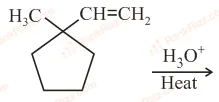
SOLUTION
-
Step 1: Protonation and Formation of the Carbocation
The starting material is a cyclopentane ring with a tertiary alcohol substituent group (specifically containing two methyl groups at the alpha position, as derived from the structures). Protonation of the hydroxyl group () by the acid turns it into an excellent leaving group (). Water is eliminated, leaving behind a secondary carbocation outside the ring.
-
Step 2: Wagner-Meerwein Ring Expansion
The initial carbocation is adjacent to a strained five-membered cyclopentane ring. To relieve angle strain and form a more stable ring, a 1,2-alkyl shift occurs where one of the C-C bonds of the cyclopentane ring breaks and migrates to the carbocation carbon. This expands the five-membered ring into a much more stable six-membered cyclohexyl carbocation ring system.
-
Step 3: Deprotonation to Form the Most Stable Alkene
Finally, a water molecule acts as a weak base and removes a proton () from the adjacent carbon atom to establish a double bond. Following Zaitsev's Rule, elimination happens to yield the most highly substituted, conjugated, and thermodynamically stable tetrasubstituted alkene possible.
Conclusion:
The ring expansion transforms the cyclopentane framework into a cyclohexane ring containing a double bond between two carbons that both bear a methyl group. This corresponds to 1,2-dimethylcyclohexene, which is illustrated as the correct option in Option B.
Answer: Option B
Tagged Electrophilic addition to alkenes. Machine-assigned, so read it as a strong shortlist rather than a verdict.