JEE Main 2021 Chemistry question — Oxidation and reduction of alkenes
SOLUTION
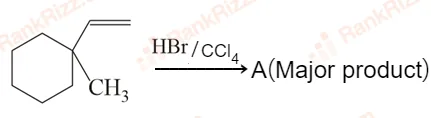
The reaction involves electrophilic addition of:
to the alkene:
The reaction follows Markovnikov addition and proceeds through a carbocation intermediate.
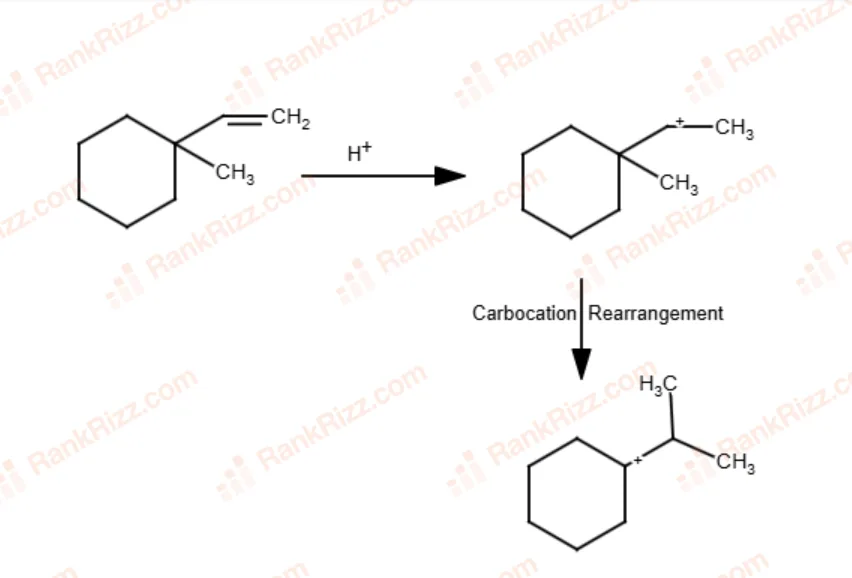
First, protonation of the double bond occurs.
According to Markovnikov’s rule, the proton adds to the terminal carbon:
forming the more stable secondary carbocation.
This secondary carbocation lies adjacent to a quaternary carbon of the cyclohexane ring.
To form a more stable carbocation, a:
takes place.
The methyl group migrates from the ring carbon to the carbocation centre.
This produces a highly stable tertiary carbocation on the ring carbon.
Simultaneously, the side chain becomes:
(isopropyl group).
Ring expansion is less favoured because converting a six-membered ring into a seven-membered ring increases ring strain.
Finally, the bromide ion attacks the tertiary carbocation.
Thus, the major product formed is:
Tagged Oxidation and reduction of alkenes. Machine-assigned, so read it as a strong shortlist rather than a verdict.