JEE Main 2021 Chemistry question — Electrophilic addition to alkenes
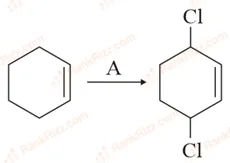
Identify the reagent(s) 'A' and condition(s) for the reaction:
SOLUTION
The reaction shown is an allylic substitution reaction.
The starting compound is cyclohexene.
In the product, the double bond remains unchanged, while chlorine atoms replace the hydrogens at the allylic positions.
Allylic positions are the carbon atoms adjacent to the: bond.
(A) would undergo electrophilic addition across the double bond.
The double bond would be destroyed.
Hence, this does not give the required product.
(B) does not produce allylic substitution in alkenes.
It also leads to addition reactions. Hence, incorrect.
(D) in dark undergoes electrophilic addition across the double bond.
Thus, the double bond disappears. Hence, incorrect.
(C)
proceeds through a free radical mechanism.
UV light causes homolytic cleavage:
The chlorine radical abstracts an allylic hydrogen to form a resonance-stabilised allylic radical.
This radical then reacts with another:
molecule to form allylic chloride while retaining the double bond. Hence, allylic chlorination occurs.
Therefore, the correct reagent is:
Correct option:
Tagged Electrophilic addition to alkenes. Machine-assigned, so read it as a strong shortlist rather than a verdict.