JEE Main 2019 Chemistry question — Electrophilic addition to alkenes
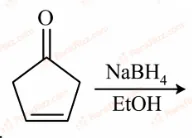
The major product of the following reaction is:
SOLUTION
We are given the substrate cyclopentanone, which is a five-membered cyclic ketone having the carbonyl group at one of the ring carbons. The reagent set is sodium borohydride in ethanol, written as
First, we recall the general reduction formula for a ketone by sodium borohydride. The well-known relationship is
Stated in words, NaBH4 delivers a hydride ion to the electrophilic carbonyl carbon, converting the into an alkoxide The protic solvent (here ethanol) then protonates that alkoxide to give the corresponding alcohol.
Applying this step by step to cyclopentanone, we have
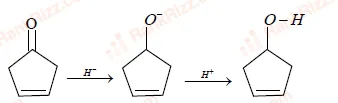
1. Hydride addition:
2. Protonation by ethanol (the solvent is an available proton donor):
Combining the two stages, the net result is conversion of the ketone functional group into a single hydroxyl group without adding any other substituent. Therefore the ring now bears an at the same carbon that formerly possessed the carbonyl.
So we obtain cyclopentanol, a secondary alcohol in a five-membered ring, and nothing else such as an group or a double bond is introduced. Among the listed choices, the structure that matches is simply “Cyclopentanol.”
Hence, the correct answer is Option C.
Tagged Electrophilic addition to alkenes. Machine-assigned, so read it as a strong shortlist rather than a verdict.