JEE Main 2019 Chemistry question — Alkenes: preparation and stability
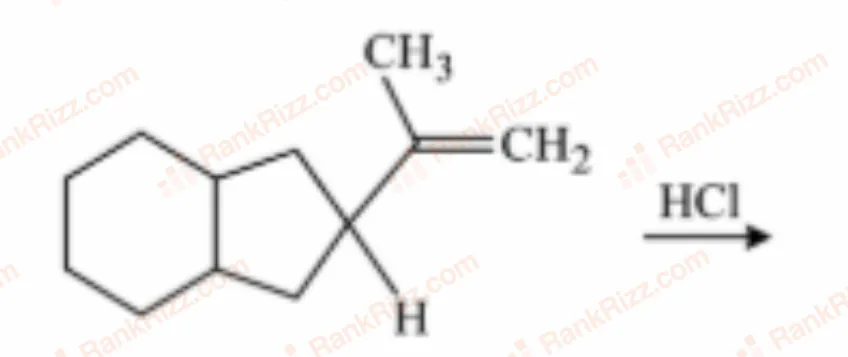
The major product of the following reaction is:
SOLUTION
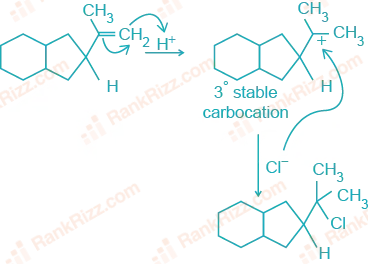
The reaction begins with the generation of an initial carbocation intermediate (typically via the protonation and loss of a leaving group like a hydroxyl group or via electrophilic addition to an alkene). The carbocation forms.
-
Nucleophilic Attack by Chloride Ion ():
The chloride ion () acts as a nucleophile. It attacks the electron-deficient sp2 hybridized carbocation carbon:
Analyzing the Final Product Structure:
Based on the provided mechanism diagram:
- The parent framework consists of a fused bicyclic ring system (a 6-membered ring fused to a 5-membered or 6-membered ring).
- An exocyclic group contains an isopropyl-like unit where the rearrangement takes place.
- The chloride ion attacks the tertiary carbon center bearing the two methyl () groups, resulting in a tertiary alkyl chloride derivative as the final stable major product: .
Conclusion:
The major product is formed via a thermodynamic pathway favored by the generation of a stable tertiary carbocation intermediate, followed by direct nucleophilic capture by the chloride ion.
Answer: The option corresponding to the structure containing the chlorine atom attached to the tertiary carbon carrying the two methyl groups on the bicyclic framework (Option D).
Tagged Alkenes: preparation and stability. Machine-assigned, so read it as a strong shortlist rather than a verdict.