JEE Main 2019 Chemistry question — Alkenes: preparation and stability
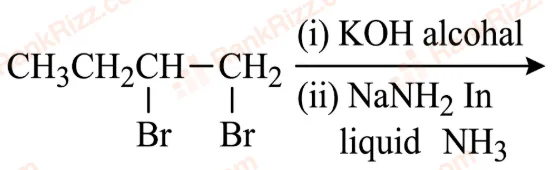
The major product of the following reaction is:
SOLUTION
We first look carefully at the given substrate. Numbering the carbon chain from the left it is - that is, a vicinal (adjacent) 1,2-dibromide.
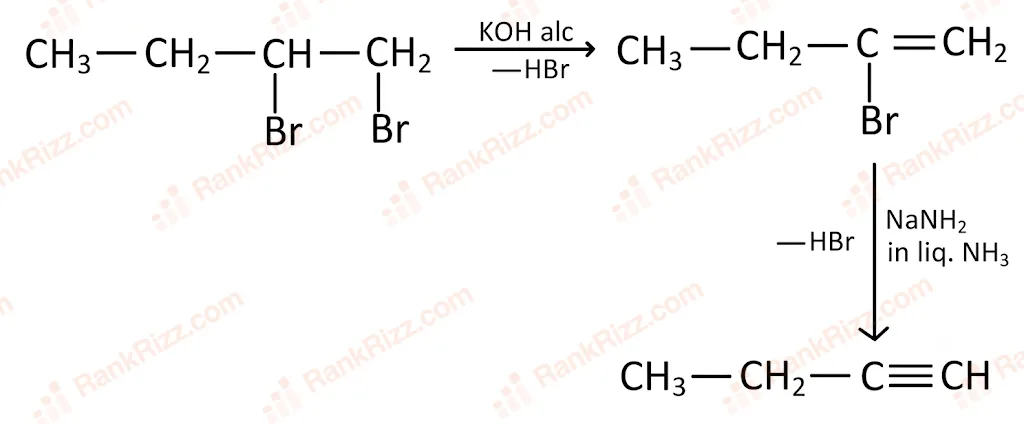
Step (i) : treatment with alcoholic - E2 dehydro-halogenation. The E2 rule tells us that one bromine atom and a β-hydrogen situated anti-periplanar to it are lost simultaneously as and to give an alkene. On there is the leaving group ; the β-hydrogens that can be removed are found on . Removing the hydrogen from together with the bromine on produces the following alkene:
This product is called 3-bromobut-1-ene (or 1-bromo-1-butene). Note that only ONE molecule of has been removed, so the molecule still contains one bromine atom, now attached directly to the vinylic carbon .
Step (ii) : treatment with in liquid - very strong base. A vinylic bromide such as undergoes another elimination of when it is exposed to a base as strong as sodamide. The general rule (which should be stated) is: “A geminal or vinylic halide, when treated with excess in liquid , loses a second molecule of to give an alkyne.”
Applying the rule, the base abstracts the sole vinylic hydrogen on , the bromide ion departs from , and a second π-bond is introduced between and . Because there is already one π-bond there, a second π-bond converts it into a triple bond:
Thus after the two successive eliminations (one normal E2 and one very strong-base vinylic E2) the vicinal dibromide is transformed into the terminal alkyne , i.e. 1-butyne.
Among the options supplied, this structure corresponds to Option C.
Hence, the correct answer is Option C.
Tagged Alkenes: preparation and stability. Machine-assigned, so read it as a strong shortlist rather than a verdict.