JEE MAIN 2015 · 11 APR ONLINE+4 / −1MEDIUMTRANSCRIBED
JEE Main 2015 Chemistry question — Electrophilic addition to alkenes
What is the major product expected from the following reaction?
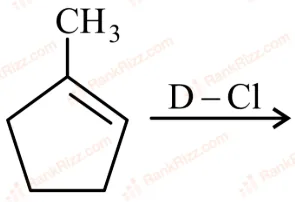
Where D is an isotope of hydrogen.
SOLUTION
Key idea: Electrophilic addition of D–Cl follows Markovnikov's rule. adds to the less substituted alkene carbon to give the tertiary carbocation, and ends up on the tertiary carbon. Addition of HX to a cyclic alkene is mainly anti.
- 1-Methylcyclopentene: adds to C-2 (the CH), which gives a tertiary cation at C-1 (the one carrying ).
- bonds to C-1, so C-1 carries and Cl, and C-2 carries D and H. This rules out (B) and (D), where D sits on C-1.
- Between (A) and (C): with anti addition, D and Cl end up on opposite faces of the ring. In (A), D points up while Cl points down (trans). In (C), D and Cl are on the same face.
Product: 1-chloro-2-deuterio-1-methylcyclopentane with D and Cl trans.
Answer: (A)
Tagged Electrophilic addition to alkenes. Machine-assigned, so read it as a strong shortlist rather than a verdict.