JEE Main 2019 Chemistry question — Electrophilic addition to alkenes
The major product of the following reaction is:
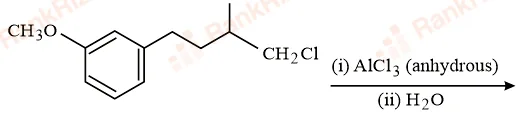
SOLUTION
1. Generation of the Carbocation
The primary alkyl chloride reacts with the Lewis acid, anhydrous aluminium chloride (AlCl3), to form a complex. Because it is a primary carbon, it can undergo a synchronized hydride shift as the leaving group departs to form a more stable carbocation directly:
- A hydride (H-) shifts from the adjacent secondary carbon to the terminal carbon.
- This expels the [AlCl4]- leaving group and creates a more stable secondary carbocation.
2. Further Carbocation Rearrangement (Hydride Shift)
The newly formed secondary carbocation is separated from the electron-rich aromatic ring by a chain of CH2 groups. To achieve the most stable intermediate before ring closure, another 1,2-hydride shift occurs along the alkyl chain.
- This moves the positive charge closer to the benzene ring, generating an even more stable secondary carbocation position that sets up a highly favorable 6-membered ring closure.
3. Intramolecular Electrophilic Aromatic Substitution (Ring Closure)
The methoxy group (-OCH3) attached to the benzene ring is a strong ortho/para-directing group due to resonance activation.
- The position para to the methoxy group is stericly less hindered and highly nucleophilic.
- The benzene ring attacks the rearranged carbocation intermediate intramolecularly.
- This ring-closure forms a fused 6-membered ring (a tetralin derivative).
4. Aromatization and Hydrolysis
Loss of a proton (H+) restores the aromaticity of the benzene ring. The subsequent addition of water (H2O) during the workup step breaks down the aluminum complexes.
Final Major Product Structure
The final product is a 6-membered saturated ring fused to the methoxybenzene ring system, specifically forming at the position para to the methoxy group.
Tagged Electrophilic addition to alkenes. Machine-assigned, so read it as a strong shortlist rather than a verdict.