JEE MAIN 2016 · 10 APR ONLINE+4 / −1MEDIUMTRANSCRIBED
JEE Main 2016 Chemistry question — Electrophilic aromatic substitution
Consider the reaction sequence below:
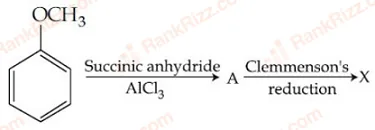
X is:
SOLUTION
Key idea: directs Friedel–Crafts acylation by succinic anhydride to the para position. Clemmensen reduction then turns the C=O into . If the chain is ring-closed (the usual Haworth tetralin route), the closure happens ortho to the chain, so OMe ends up at C-6 of the tetralin.
- FC acylation: anisole + succinic anhydride/ gives (A).
- Clemmensen, Zn(Hg)/HCl: , 4-(4-methoxyphenyl)butanoic acid.
- Ring closure onto the ring ortho to the chain, then reduction of the new C=O, gives the tetralin skeleton. The OMe, originally para to the chain, is now at C-6: 6-methoxy-1,2,3,4-tetralin.
- (A) and (B) are diols, which Clemmensen reduction does not produce. (C) has OMe next to the ring fusion, which would need ortho acylation. That leaves (D).
Answer: (D) 6-methoxytetralin
Tagged Electrophilic aromatic substitution. Machine-assigned, so read it as a strong shortlist rather than a verdict.