JEE MAIN 2024 · 04 APR S2+4 / −1MEDIUMTRANSCRIBED
JEE Main 2024 Chemistry question — Electrophilic addition to alkenes
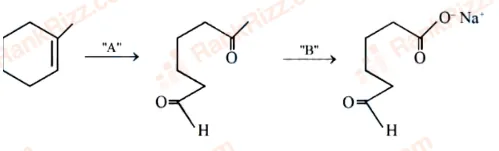
In the above chemical reaction sequence "A" and "B" respectively are:
SOLUTION
Key idea: Ozonolysis cuts the ring C=C open into a keto-aldehyde. The haloform reaction then converts only the methyl ketone into a carboxylate.
- 1-Methylcyclohexene has a trisubstituted C=C. Reductive ozonolysis (, then ) breaks it: The carbon that carried the becomes a methyl ketone, and the other carbon becomes . This matches the first product shown. So A = , .
- The second step turns into and loses one carbon. That is the iodoform reaction: So B = .
- would only hydrate the alkene to an alcohol. would not cleave off the methyl group in this way.
Answer: (B)
Tagged Electrophilic addition to alkenes. Machine-assigned, so read it as a strong shortlist rather than a verdict.