JEE Main 2024 Chemistry question — Directive influence of substituents
Total number of deactivating groups in aromatic electrophilic substitution reaction among the following is:
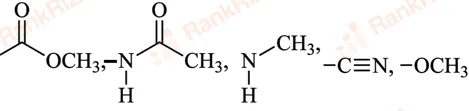
SOLUTION
is a deactivating group because the carbonyl carbon attached directly to the aromatic ring withdraws electron density through both the and effects, making the ring less reactive toward electrophilic aromatic substitution.
is an activating group because the nitrogen atom attached directly to the ring can donate its lone pair into the aromatic system through resonance. Although the adjacent carbonyl group reduces this donation, the net effect remains activating.
is a strongly activating group because the nitrogen atom possesses a free lone pair that is readily delocalized into the aromatic ring, increasing its electron density through a strong effect.
is a deactivating group because it strongly withdraws electron density from the aromatic ring through both the and effects, thereby decreasing the ring's reactivity.
is an activating group because the oxygen atom donates electron density to the aromatic ring through resonance. Its effect dominates over its effect, resulting in overall activation.
Therefore, the deactivating groups are and . Hence, the number of deactivating groups is .
Tagged Directive influence of substituents. Machine-assigned, so read it as a strong shortlist rather than a verdict.