JEE MAIN 2024 · 09 APR S1+4 / −1MEDIUMTRANSCRIBED
JEE Main 2024 Chemistry question — Haloarenes
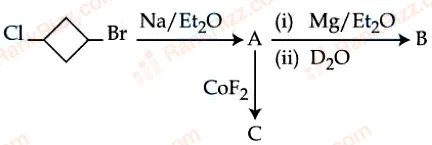
In the following sequence of reaction, the major products B and C respectively are :
SOLUTION
Key idea: In a Wurtz reaction, the C–Br bond reacts with Na much faster than C–Cl. Then a Grignard/D₂O step replaces the halogen with D, and swaps Cl for F (Swarts reaction).
- A: with Na/ether, two molecules couple at their C–Br carbons. This gives 3,3′-dichloro-1,1′-bi(cyclobutyl), ; the C–Cl bonds survive.
- B: with Mg/ether, each C–Cl becomes C–MgCl, and D₂O then gives C–D. So B is .
- C: with (Swarts), Cl is replaced by F. So C is .
- This matches option (D): the bicyclobutyl compound with D at both ends, and the one with F at both ends.
Answer: (D)
Tagged Haloarenes. Machine-assigned, so read it as a strong shortlist rather than a verdict.