JEE MAIN 2018 · 08 APR OFFLINE+4 / −1TRANSCRIBED
JEE Main 2018 Chemistry question — Nucleophilic substitution (SN1 and SN2)
The major product of the following reaction is: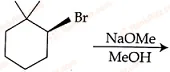
SOLUTION
Key idea: A strong base (NaOMe) with a secondary halide favours E2; the double bond can only form towards a carbon that carries a -H.
- The substrate is 2-bromo-1,1-dimethylcyclohexane. The C–Br carbon (C2) has two -carbons: C1 and C3.
- C1 is quaternary (two groups, no H), so no H can be removed from it.
- SN2 at C2 is strongly hindered by the adjacent gem-dimethyl group (neopentyl-like), so substitution (options A, B) is not the major path.
- E2 removes an anti-periplanar H from C3, giving the C2=C3 double bond:
- Option (D) (1,2-dimethylcyclohexene) would need a carbocation and a methyl shift (E1), which is not expected with a strong base like methoxide.
Answer: (C) 3,3-dimethylcyclohexene
Tagged Nucleophilic substitution (SN1 and SN2). Machine-assigned, so read it as a strong shortlist rather than a verdict.