JEE MAIN 2020 · 07 JAN S2+4 / −1MEDIUMTRANSCRIBED
JEE Main 2020 Chemistry question — Nucleophilic substitution (SN1 and SN2)
For the following reactions
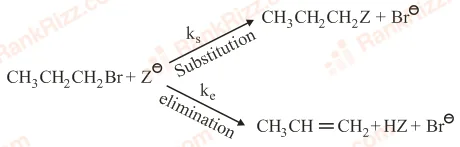
where:
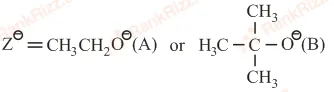
k and k are respectively the rate constants for substitution and elimination, and , the correct option is
SOLUTION
We need to compare the relative rates of substitution () and elimination () for a primary alkyl halide reacting with two different alkoxide bases: Ethoxide ion (A) and tert-Butoxide ion (B).
Core Chemical Principles:
- Ethoxide ion ( - A): A small, sterically unhindered nucleophile/base. It easily attacks the carbon center, making substitution () the major pathway. Thus, is high and is large.
- tert-Butoxide ion ( - B): A bulky, highly sterically hindered base. The steric crowding prevents it from attacking the carbon center for substitution, forcing it to abstract a peripheral proton to undergo elimination (). Thus, elimination is strongly favored, meaning and is very small.
Comparison Results:
- Since substitution is favored with the unhindered base A and elimination dominates with the bulky base B, we have:
- Because tert-butoxide is a stronger, bulkier base designed specifically to drive elimination pathways, its elimination rate constant is significantly higher:
Conclusion:
Steric hindrance in the tert-butoxide base suppresses substitution while accelerating elimination compared to the unhindered ethoxide base.
Answer: Option B — and
Tagged Nucleophilic substitution (SN1 and SN2). Machine-assigned, so read it as a strong shortlist rather than a verdict.