JEE MAIN 2026 · 04 APR S1+4 / −1EASYTRANSCRIBED
JEE Main 2026 Chemistry question — Haloarenes
Match the LIST-I with LIST-II.
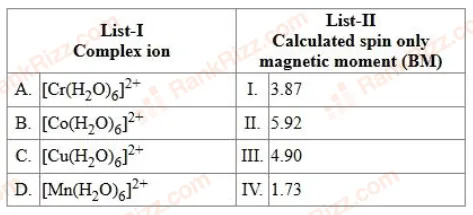
choose the correct answer from the options given below
SOLUTION
The spin-only magnetic moment () is calculated using the formula:
where is the number of unpaired electrons
A.
- Oxidation State: is in the state ().
- Electronic Configuration: Ground state is .
Removing 2 electrons gives . - Crystal Field Splitting: is a weak-field ligand, so it forms a high-spin complex ().
- Unpaired Electrons ():
- Magnetic Moment:
- Match: A III
B.
- Oxidation State: is in the state ().
- Electronic Configuration: Ground state is .
Removing 2 electrons gives . - Crystal Field Splitting: is a weak-field ligand, leading to a high-spin complex ().
- Unpaired Electrons ():
- Magnetic Moment:
- Match: B I
C.
- Oxidation State: is in the state ().
- Electronic Configuration: Ground state is .
Removing 2 electrons gives . - Crystal Field Splitting: High-spin arrangement ().
- Unpaired Electrons ():
- Magnetic Moment:
- Match: C IV
D.
- Oxidation State: is in the state ().
- Electronic Configuration: Ground state is .
Removing 2 electrons gives . - Crystal Field Splitting: is a weak-field ligand, leading to a high-spin complex ().
- Unpaired Electrons ():
- Magnetic Moment:
- Match: D II
Hence, Option D is correct.
Tagged Haloarenes. Machine-assigned, so read it as a strong shortlist rather than a verdict.