JEE MAIN 2022 · 29 JUN S2+4 / −1MEDIUMTRANSCRIBED
JEE Main 2022 Chemistry question — Nucleophilic substitution (SN1 and SN2)

The stable carbocation formed in the above reaction is:
SOLUTION
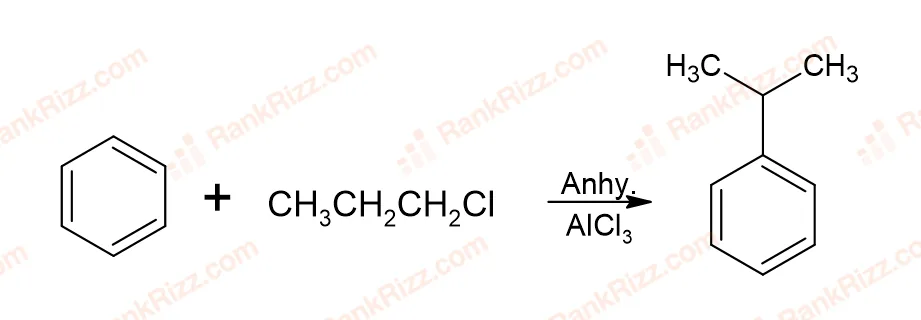
The major product 'A' is Cumene (also known as Isopropylbenzene).
When benzene reacts with 1-chloropropane in the presence of anhydrous , a carbocation rearrangement occurs.
Carbocation Formation: The Lewis acid abstracts the chloride ion, forming a primary carbocation:
.
Rearrangement: A 1,2-hydride shift occurs to convert the unstable primary carbocation into a more stable secondary carbocation:
(isopropyl carbocation).
which is the most stable carbocation formed during this reaction.
Hence, Option C is Correct.
Tagged Nucleophilic substitution (SN1 and SN2). Machine-assigned, so read it as a strong shortlist rather than a verdict.