JEE MAIN 2022 · 29 JUN S1+4 / −1MEDIUMTRANSCRIBED
JEE Main 2022 Chemistry question — Haloarenes
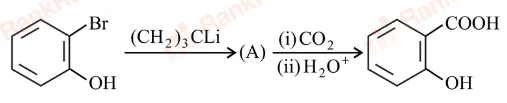
In the given conversion the compound A is:
SOLUTION
Key idea: An organolithium first acts as a base on the acidic phenol O–H, then does lithium–halogen exchange with the aryl bromide. The aryllithium is then carboxylated by .
- t-BuLi (2 equivalents) with 2-bromophenol:
- Acid–base:
- Li–Br exchange:
- A = the dilithio species: Li on the ring carbon and OLi on oxygen ().
- then : giving salicylic acid, as shown.
- (A) is impossible because a free O–H would immediately destroy a C–Li bond; (C) and (D) show alkylation, not what organolithiums do here.
Answer: (B)
Tagged Haloarenes. Machine-assigned, so read it as a strong shortlist rather than a verdict.