JEE MAIN 2025 · 29 JAN S1+4 / −1MEDIUMTRANSCRIBED
JEE Main 2025 Chemistry question — Haloarenes
In The following substitution reaction :
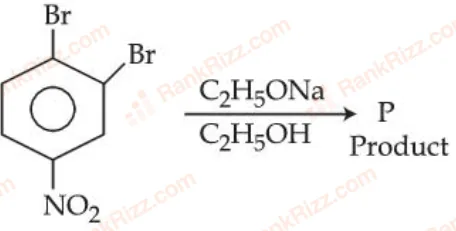
product 'P'formed is :
SOLUTION
Key idea: Nucleophilic aromatic substitution () needs an electron-withdrawing group ortho or para to the leaving group. Only that position lets stabilise the Meisenheimer complex.
- The substrate is 3,4-dibromonitrobenzene: one Br is para to (C-4) and one is meta (C-3).
- When attacks C-4, the negative charge of the σ-complex spreads onto the nitro oxygens. That makes this pathway fast.
- When attacks C-3, the charge never reaches the carbon carrying . There is no stabilisation, so no substitution happens there.
- So only the para Br is replaced: P is 2-bromo-1-ethoxy-4-nitrobenzene, structure (D).
itself is not displaced, which rules out (A).
Answer: (D)
Tagged Haloarenes. Machine-assigned, so read it as a strong shortlist rather than a verdict.