JEE MAIN 2022 · 28 JUN S1+4 / −1MEDIUMTRANSCRIBED
JEE Main 2022 Chemistry question — Nucleophilic substitution (SN1 and SN2)
The major product (P) in the reaction

SOLUTION
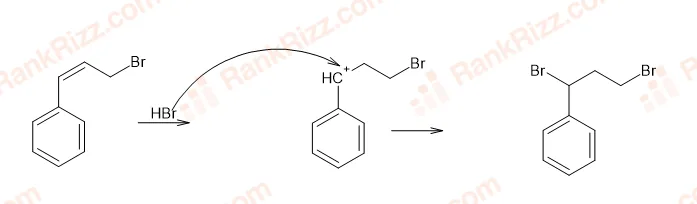
The alkene reacted with acts as a nucleophile and attacks the proton (). The double bond breaks to form the most stable possible carbocation intermediate.
The positive charge on the carbon directly attached to the benzene ring is a benzylic carbocation. It is exceptionally stable because the positive charge can be delocalized throughout the -system of the aromatic ring via resonance.
Once the stable benzylic carbocation intermediate is formed, the bromide ion () attacks the electron-deficient benzylic carbon.
Therefore, Option B is correct
Tagged Nucleophilic substitution (SN1 and SN2). Machine-assigned, so read it as a strong shortlist rather than a verdict.