JEE Main 2021 Chemistry question — Nucleophilic substitution (SN1 and SN2)
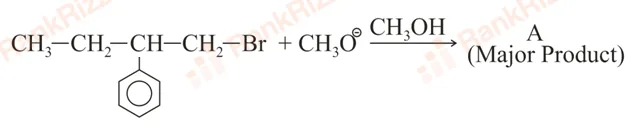
The major product (A) formed in the reaction given below is:
SOLUTION
The given substrate is 1-bromo-2-phenylbutane, in which the bromine atom is attached to a primary carbon.
Although primary alkyl halides generally undergo substitution with strong nucleophiles, the adjacent -carbon in this molecule is highly substituted, bearing both a phenyl group and an ethyl group. This creates significant steric hindrance around the reaction center.
The reagent used is methoxide ion in methanol, which acts as both a strong nucleophile and a strong base.
Because backside attack required for the mechanism is hindered by the bulky substituents on the adjacent carbon, substitution becomes unfavorable. Instead, the methoxide ion abstracts the -hydrogen, leading to an elimination.
During the elimination process:
- The base removes the hydrogen atom from the -carbon.
- Simultaneously, the bromide ion leaves from the -carbon.
- A double bond is formed between the - and -carbons.
The resulting product is
This alkene is especially stable because the newly formed double bond is conjugated with the phenyl ring, allowing resonance stabilization of the -system. The additional stability of the conjugated alkene strongly favors elimination over substitution.
Hence, the major product is 2-phenylbut-1-ene,
Therefore, the correct answer is Option (A).
Tagged Nucleophilic substitution (SN1 and SN2). Machine-assigned, so read it as a strong shortlist rather than a verdict.