JEE Main 2022 Chemistry question — Nucleophilic substitution (SN1 and SN2)
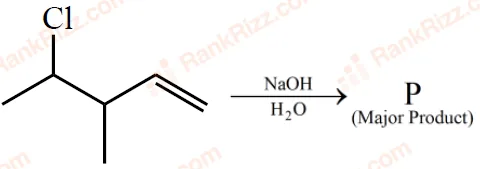
Consider the above reaction. The number of electrons present in the product 'P' is ______
SOLUTION
The reaction proceeds through an mechanism because the solvent is polar protic.
First, the chloride ion leaves, generating a secondary carbocation.
To attain greater stability, a occurs from the adjacent tertiary allylic carbon.
This forms a more stable tertiary allylic carbocation stabilized by resonance and inductive effects.
The nucleophile then attacks the carbocation to form the alcohol product.
The final product retains one carbon-carbon double bond.
A double bond contains:
Each covalent bond contains two electrons.
Hence, the number of electrons present in product is:
Correct Answer:
Tagged Nucleophilic substitution (SN1 and SN2). Machine-assigned, so read it as a strong shortlist rather than a verdict.