JEE MAIN 2026 · 24 JAN S1+4 / −1MEDIUMTRANSCRIBED
JEE Main 2026 Chemistry question — Nucleophilic substitution (SN1 and SN2)
Given below are two statements:
Statement I: 'C - Cl' bond is stronger in
Statement II: The given optically active molecule,
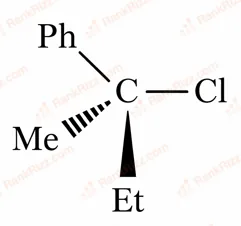
on hydrolysis gives a solution that can rotate the plane polarized light.
In the light of the above statements, choose the correct answer from the options given below
SOLUTION
Correct Answer: Statement I is true but Statement II is false.
- Statement I is True: In (vinyl chloride), the lone pair on the chlorine atom is in conjugation with the -bond: This resonance resonance gives the bond partial double bond character, making it shorter and stronger than the pure single bond (attached to an carbon) in .
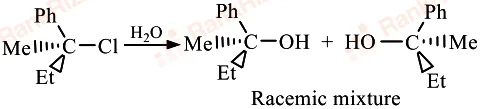
- Statement II is False: The given tertiary benzylic halide, , undergoes hydrolysis via an mechanism. It proceeds through a planar carbocation intermediate . Nucleophilic attack occurs with equal probability from both faces, yielding a racemic mixture that is optically inactive and cannot rotate plane-polarized light.
Tagged Nucleophilic substitution (SN1 and SN2). Machine-assigned, so read it as a strong shortlist rather than a verdict.