JEE Main 2026 Chemistry question — Nucleophilic substitution (SN1 and SN2)
Consider all the structural isomers with molecular formula are separately treated with KOH(aq) to give respective substitution products, without any rearrangement. The number of products which can exhibit optical isomerism from these is ______.
SOLUTION
We need to find all structural isomers of , treat each with aqueous KOH (SN2/SN1 substitution, no rearrangement), and count how many products exhibit optical isomerism.
The structural isomers of (monobromopentanes) are:
1. (1-bromopentane)
2. (2-bromopentane)
3. (3-bromopentane)
4. (1-bromo-3-methylbutane)
5. (2-bromo-3-methylbutane)
6. (2-bromo-2-methylbutane)
7. (1-bromo-2,2-dimethylpropane / neopentyl bromide)
8. (1-bromo-2-methylbutane)
Now, substitution with KOH(aq) replaces Br with OH. The product is the corresponding alcohol. For optical isomerism, the product must have a chiral center (asymmetric carbon).
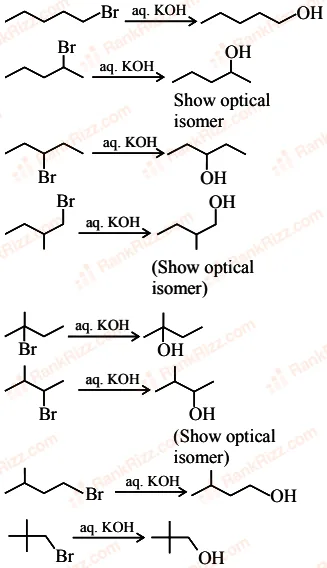
The products that can exhibit optical isomerism are: 2-pentanol (from isomer 2), 3-methyl-2-butanol (from isomer 5), and 2-methyl-1-butanol (from isomer 8).
The answer is 3.
Tagged Nucleophilic substitution (SN1 and SN2). Machine-assigned, so read it as a strong shortlist rather than a verdict.