JEE MAIN 2026 · 22 JAN S1+4 / −1MEDIUMTRANSCRIBED
JEE Main 2026 Chemistry question — Nucleophilic substitution (SN1 and SN2)
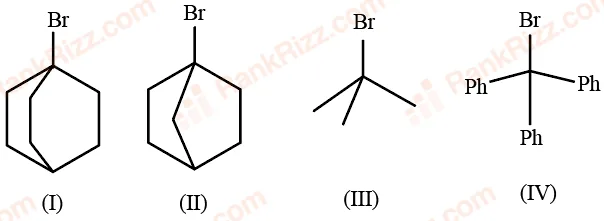
The correct order of the rate of reaction of the following reactants with nucleophile by mechanism is :
(Given: Structures I and II are rigid)
SOLUTION
- (IV) Triphenylmethyl bromide: The resulting carbocation is highly stabilized by resonance with three phenyl rings. This is the most stable cation in the set, leading to the fastest rate.
- (III) tert-Butyl bromide: The carbocation is stabilized by the inductive effect and hyperconjugation from three methyl groups. While stable, it lacks the extensive resonance of (IV).
- (I) & (II) Bridgehead Bromides: These react the slowest due to Bredt's Rule.
- An reaction requires the carbocation to adopt a planar geometry.
- In rigid bicyclic systems, the bridgehead carbon cannot become planar because of the geometric constraints of the rings. This creates immense "ring strain."
- Structure (II) is smaller and more rigid than Structure (I), making it even harder to achieve planarity. Therefore, (II) is the least reactive.
Tagged Nucleophilic substitution (SN1 and SN2). Machine-assigned, so read it as a strong shortlist rather than a verdict.