JEE Main 2025 Chemistry question — Nucleophilic substitution (SN1 and SN2)
Given below are two statements : Statement I : will undergo reaction though it is a
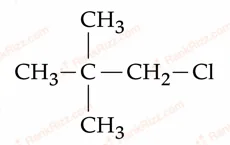
primary halide. Statement II :
will not undergo reaction very easily though it is a primary halide. In the light of the above statements,
choose the most appropriate answer from the options given below :
SOLUTION
Consider the halide (chloromethyl methyl ether). Although the carbon bearing chlorine is formally primary, the adjacent oxygen atom strongly influences both and pathways.
Statement I : Tendency towards reaction
1. In an mechanism, the rate-determining step is heterolytic cleavage of the bond to give a carbocation.
2. Loss of from produces the carbocation .
3. The lone pair on oxygen can overlap with the empty orbital on the carbocation, giving the resonance pair
This neighbouring-group participation stabilises the carbocation far more than in an ordinary primary halide. Because the intermediate is resonance-stabilised, the energy barrier for ionisation is low and the compound readily follows an pathway. Hence Statement I is correct.
Statement II : Reluctance towards reaction
1. An reaction requires backside attack of the nucleophile on the bond.
2. The same lone-pair donation that stabilises the carbocation also introduces partial double-bond character in the ground state. This raises the electron density on the carbon undergoing substitution, so the carbon is less electrophilic than in a typical primary halide.
3. In addition, the oxygen lone pairs create electronic (and a little steric) repulsion for an approaching nucleophile from the backside. As a result, the transition state for is destabilised and the rate drops sharply compared with normal primary halides.
Therefore the compound “will not undergo reaction very easily”, making Statement II correct.
Since both statements are correct, the appropriate choice is:
Option B which is: Both Statement I and Statement II are correct
Tagged Nucleophilic substitution (SN1 and SN2). Machine-assigned, so read it as a strong shortlist rather than a verdict.