JEE MAIN 2025 · 04 APR S2+4 / −1MEDIUMTRANSCRIBED
JEE Main 2025 Chemistry question — Nucleophilic substitution (SN1 and SN2)
Consider the following molecule (X). The structure of X is
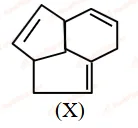
The major product formed when the given molecule (X) is treated with HBr (1 eq) is:
SOLUTION
Key idea: With 1 equivalent of HBr, the most substituted alkene reacts. Its protonation gives the most stable (tertiary) carbocation, and adds there (Markovnikov).
- X has three isolated C=C bonds:
- in the left five-membered ring, a disubstituted CH=CH;
- in the six-membered ring, a disubstituted CH=CH;
- in the lower five-membered ring, a trisubstituted C=CH, where one carbon is the ring-fusion carbon shared with the six-membered ring.
- Protonating either disubstituted alkene gives only a secondary cation. Protonating the trisubstituted alkene at its CH end gives a tertiary carbocation at the ring-fusion carbon.
- Bromide captures that tertiary cation, so Br ends up on the ring-fusion carbon. The other two C=C bonds are untouched:
- This is structure (B). (A), (C) and (D) come from secondary cations and are minor.
Answer: (B)
Tagged Nucleophilic substitution (SN1 and SN2). Machine-assigned, so read it as a strong shortlist rather than a verdict.