JEE Main 2025 Chemistry question — Nucleophilic substitution (SN1 and SN2)
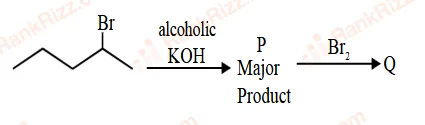
Consider the above sequence of reactions. 151 g of 2-bromopentane is made to react. Yield of major product P is 80% whereas Q is 100%.
Mass of product Q obtained is _________ g.
(Given molar mass in g mol H: 1, C: 12, O: 16, Br: 80)
SOLUTION
The problem can be solved by first identifying the products formed in each reaction step and then carrying out the required stoichiometric calculations.
In the first step, the starting compound is 2-bromopentane. When treated with alcoholic KOH, it undergoes a -elimination reaction.
According to Zaitsev's rule, the more substituted alkene is formed as the major product.
The reaction is
Hence, product P is
In the second step, pent-2-ene reacts with bromine through electrophilic addition across the double bond.
The reaction is
Therefore, product Q is
Next, calculate the molar masses.
For 2-bromopentane,
the molar mass is
For 2,3-dibromopentane,
the molar mass is
Initially,
of 2-bromopentane is taken.
Hence,
The first reaction proceeds with an
yield.
Therefore, the actual amount of product P formed is
The second reaction has
yield and follows a
stoichiometric ratio.
Hence,
Finally, the mass of product Q is
Therefore, the required mass of product Q is
Tagged Nucleophilic substitution (SN1 and SN2). Machine-assigned, so read it as a strong shortlist rather than a verdict.