JEE Main 2025 Chemistry question — Nucleophilic substitution (SN1 and SN2)
Match List-I with List-II.
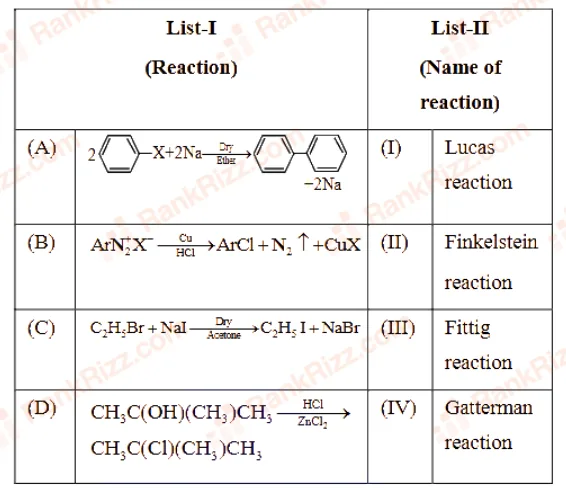
Choose the correct answer from the options given below :
SOLUTION
To match the reactions in List-I with their corresponding names in List-II, let us analyze each reaction individually.
For reaction (A),
two molecules of an aryl halide react with sodium metal in dry ether to produce a biaryl compound (biphenyl). This coupling reaction is known as the Fittig reaction.
Hence,
For reaction (B),
an aryldiazonium salt is treated with copper powder and hydrochloric acid to form an aryl chloride. The use of copper powder instead of cuprous halide identifies this transformation as the Gatterman reaction.
Hence,
For reaction (C),
an alkyl bromide is converted into an alkyl iodide using sodium iodide in dry acetone. This halogen exchange reaction is known as the Finkelstein reaction.
Hence,
For reaction (D),
a tertiary alcohol is converted into the corresponding alkyl chloride using concentrated hydrochloric acid and anhydrous zinc chloride. This reaction is known as the Lucas reaction.
Hence,
Therefore, the correct matching is
Thus, the correct answer is
Tagged Nucleophilic substitution (SN1 and SN2). Machine-assigned, so read it as a strong shortlist rather than a verdict.